



Color Scheme

Holger Zschaepitz: Good Morning from Germany…

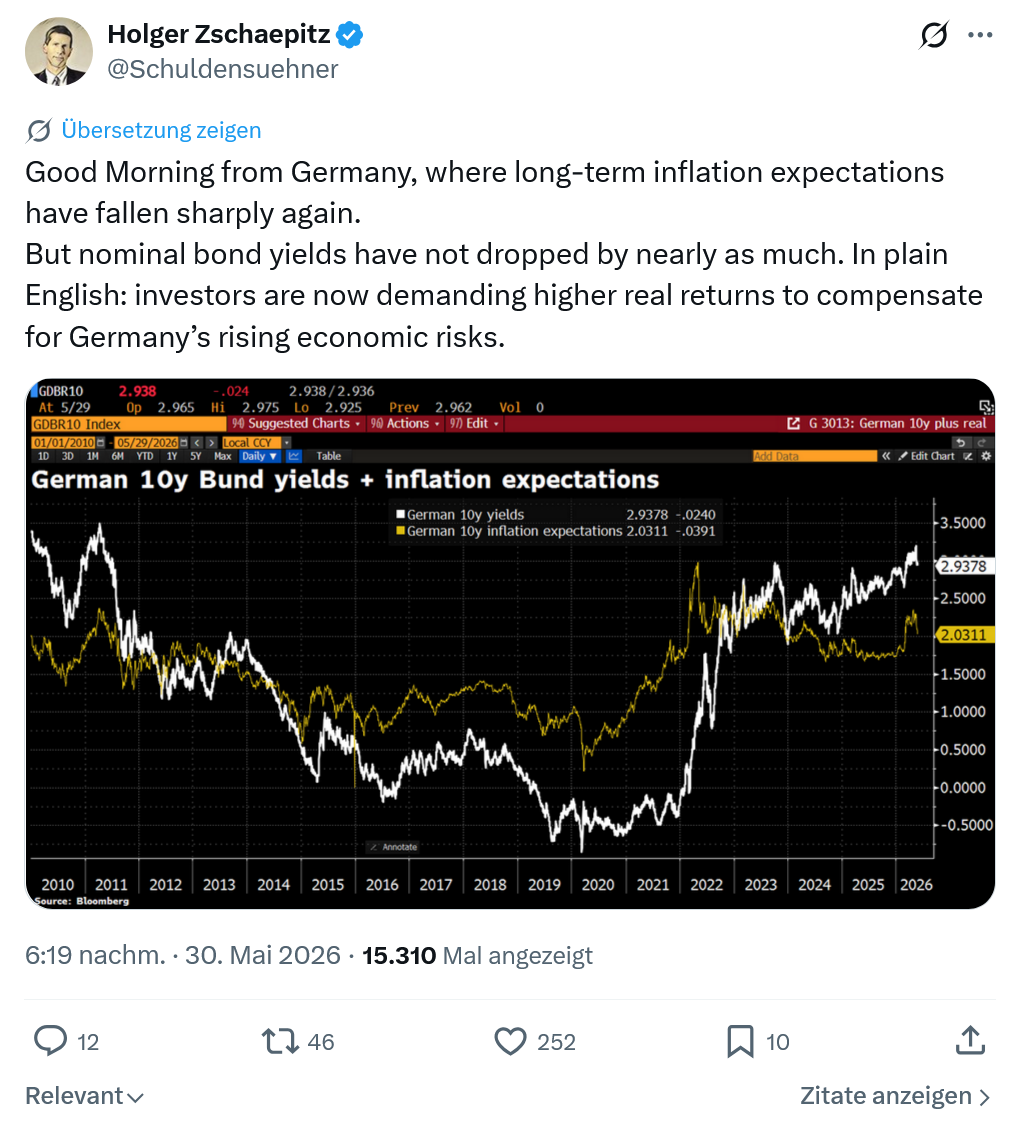
Good Morning from Germany, where long-term inflation expectations have fallen sharply again. But nominal bond yields have not dropped by nearly as much. In plain English: investors are now demanding higher real returns to compensate for Germany’s rising economic risks.
Holger Zschaepitz: Good Morning from Germany…
https://x.com/Schuldensuehner/status/2060742994752409802

Holger Zschaepitz: Good Morning from Germany, where Berlin...

Good Morning from Germany, where Berlin is trying to cool the Commerzbank drama: Chancellor Friedrich Merz says Germany is not blocking a UniCredit takeover – only rejecting the way the Italian lender approached the bank. “We have never attempted to do so,” Merz says in Summer Press Conference. “We have only ever said that the way Commerzbank was approached does not have our approval.” Translation: no veto, but no blessing either.

Holger Zschaepitz: Good Morning from Germany, where the fiscal Zeitenwende is getting bigger...

Good Morning from Germany, where the fiscal Zeitenwende is getting bigger. Berlin now plans >€1tn in new federal debt for 2026-30, w/annual borrowing >€200bn from 2027. Defense spending is set to climb toward 4% of GDP, while interest costs could jump from €30bn to >€80bn by 2030. The 2027 budget gap is closed – but the bill is merely pushed into the future. (via DB)

Holger Zschaepitz: Good Morning from Germany...

Good Morning from Germany, where AI could become the productivity lifeline for an aging economy: Germany’s working-age population may shrink by up to 25% by 2070, while AI could add 0.2-0.7pp to annual growth. Less sci-fi, more invoices, routes & admin automation. https://bloomberg.com/news/articles/2026-06-29/german-ai-rollout-offers-300-billion-fix-for-worker-shortage?sref=R17xFhjo

Holger Zschaepitz: Good Morning from Germany, where the heatwave...

Good Morning from Germany, where the heatwave is already hitting the country’s economic arteries. Rhine water levels at Kaub – a key bottleneck on Europe’s industrial waterway – have fallen 0.20m in just 3 days to around 0.83m, the lowest since April 2025. That matters: the Rhine is a crucial transport route for Germany’s chemical industry, including BASF, Covestro and Evonik. Low water can restrict barge loads, raise logistics risks and disrupt supply chains. For now, barge rates to Basel are still flat – but the heat is on.

Holger Zschaepitz: Hello from Germany, where the auto...

Hello from Germany, where the auto crisis just deepened. BMW has issued a major profit warning, implying a profit drop of >60%. Its EBIT margin is now expected at just 1–3%; a shocking level for a premium automaker that once stood for double-digit profitability. This comes only a day after VW executives reportedly described their own company as facing an existential threat, according to Manager Magazin. BMW is now worth less <€40bn.

Holger Zschaepitz: Good Morning from Germany…

Good Morning from Germany where factory orders fell more than expected in April due to the automotive industry and electrical equipment, adding to concerns that Europe’s largest economy could contract in the second quarter. New orders in the German manufacturing sector fell by 3.8% in April MoM, thereby erasing most of the growth recorded in March. https://bloomberg.com/news/articles/ 2026-06-08/german-factory-orders-fell-more-than-expected-in-april-on-cars?utm_source=website&utm_medium=share&utm_campaign=twitter

Holger Zschaepitz: Good Morning from Germany…

Good Morning from Germany, where more and more German citizens are leaving the country. Last year, 288,579 Germans moved abroad, up from 270,000 the year before – a fresh record. The number of Germans moving back to Germany rose slightly, from 189,000 to 192,000. But the net balance still worsened to almost -97,000. That is the 2nd-highest net outflow of German citizens in the country’s history. Only 2016 was worse, at -135,000.

Holger Zschaepitz: Guten Morgen aus Deutschland…

Guten Morgen aus Deutschland, wo der Arbeitsmarkt an Schwung verliert. Die Beschäftigung ist im 1. Quartal 2026 erneut gesunken. Der Schmerz konzentriert sich auf Industrie und Bauwesen, wo die Jobverluste die bescheidenen Zuwächse im Dienstleistungssektor bei Weitem übersteigen. Die große Ausnahme: Öffentliche Dienste, Bildung und Gesundheitswesen haben im 1. Quartal immerhin 181.000 neue Jobs geschaffen, ein Plus von 1,5 % im Vergleich zum Vorjahr. Auffällige Divergenz: Während die Beschäftigung in Deutschland schrumpft, steigt sie im EU- und Eurozonen-Raum weiterhin.

Holger Zschaepitz: Good Morning from Germany…

Good Morning from Germany, where house prices are rising slightly again – but only in nominal terms. After adjusting for inflation, there is still little sign of a broad-based recovery. The picture is highly uneven. New-build prices are rising, partly b/c construction costs remain elevated. In April, the Europace New Build Index increased by 1% MoM, reaching a new ATH. Existing homes, by contrast, edged lower, acc to the Europace Existing Homes Index, w/performance varying significantly by region. Year on year, price growth for both new builds and existing homes remains well below Germany’s inflation rate of 2.9%. In real terms, the housing market is therefore still largely moving sideways.

Holger Zschaepitz: Good Morning from Germany…

Good Morning from Germany, where deeply negative energy prices due to solar glut are forcing a rethink of the energy transition, w/Economy Minister calling to end subsidies for excess renewable electricity after costs ran into the tens of millions last weekend alone. https://welt.de/wirtschaft/plu s69f8f1ea23e6b3dbf3c99007/wirtschaftsrat-der-cdu-reiche-fordert-energiewende-schlussstrich-kein-geld-mehr-fuer-ueberfluessigen-oekostrom.html

Holger Zschaepitz: Good Morning from Germany…

Good Morning from Germany, where electricity prices are now regularly falling below zero around midday. On May 1, they even dropped to the floor at -49.999 cents per kilowatt hour. The reason is simple: we are generating more solar power than we can use or store. As a result, Germany has to cover the gap between these negative market prices and the guaranteed feed-in tariffs paid to producers—an expensive outcome. These prices are a clear indication of the utterly disastrous energy transition.
Read more