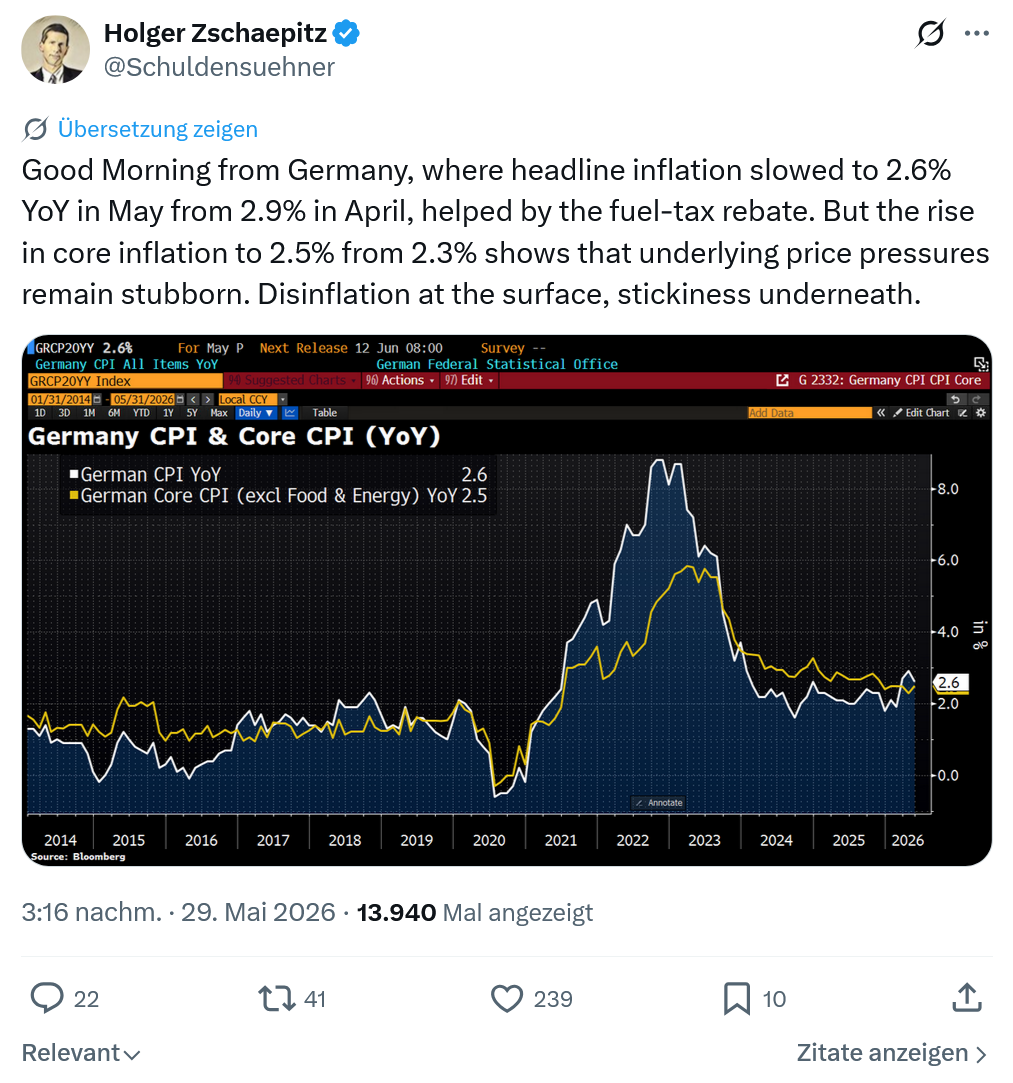



Holger Zschaepitz: Good Morning from Germany, where...
Good Morning from Germany, where the welfare state keeps expanding: Govt cash social benefits jumped 5.9% in 2025 to €751.2bn; far above the long-term avg of 3.4%. Pensions hit €417.9bn, jobless benefits surged 19.1%, while Bürgergeld fell slightly. Demography is destiny.Holger Zschaepitz: Good Morning from Germany…
Good Morning from Germany, where the road to socialism is paved with ever-rising govt consumption. Since 1999, state consumption is up 63%, while GDP has risen only 31% and capital investment a meagre 16%. The public sector keeps expanding, but the investment base is stagnating. Germany is becoming less of a market economy and more of a state-led redistribution machine.Holger Zschaepitz: Guten Morgen aus Deutschland…
Guten Morgen aus Deutschland, wo der Arbeitsmarkt an Schwung verliert. Die Beschäftigung ist im 1. Quartal 2026 erneut gesunken. Der Schmerz konzentriert sich auf Industrie und Bauwesen, wo die Jobverluste die bescheidenen Zuwächse im Dienstleistungssektor bei Weitem übersteigen. Die große Ausnahme: Öffentliche Dienste, Bildung und Gesundheitswesen haben im 1. Quartal immerhin 181.000 neue Jobs geschaffen, ein Plus von 1,5 % im Vergleich zum Vorjahr. Auffällige Divergenz: Während die Beschäftigung in Deutschland schrumpft, steigt sie im EU- und Eurozonen-Raum weiterhin.Holger Zschaepitz: Good Morning from Germany…
Good Morning from Germany, where borrowing is getting more expensive as bond yields keep rising. Long-term yields have climbed to their highest level since 2011.Holger Zschaepitz: Good Morning from Germany…
Good Morning from Germany, where wholesale prices have jumped 6.3% YoY; the steepest rise since Feb 2023. That is a worrying signal for consumers, b/c food prices often follow wholesale costs with a delay.Holger Zschaepitz: Good Morning from Germany…
Good Morning from Germany, where house prices are rising slightly again – but only in nominal terms. After adjusting for inflation, there is still little sign of a broad-based recovery. The picture is highly uneven. New-build prices are rising, partly b/c construction costs remain elevated. In April, the Europace New Build Index increased by 1% MoM, reaching a new ATH. Existing homes, by contrast, edged lower, acc to the Europace Existing Homes Index, w/performance varying significantly by region. Year on year, price growth for both new builds and existing homes remains well below Germany’s inflation rate of 2.9%. In real terms, the housing market is therefore still largely moving sideways.Holger Zschaepitz: Good Morning from Germany…
Good Morning from Germany, which appears to be heading towards stagflation. Consensus GDP forecasts for 2026 have been revised down from more than 1% to just 0.66%, while inflation forecasts have climbed above 2.7%. Against this backdrop, the ECB is now expected to raise interest rates twice – at least, that is what markets are pricing in.Holger Zschaepitz: Good Morning from Germany, where...
Good Morning from Germany, where taxes and social security contributions now take almost half of the avg gross salary. About 14% goes to income taxes, while roughly 35% is spent on non-wage labor costs such as pensions, health insurance, and unemployment insurance. Among developed countries, only Belgium has a higher overall burden.Holger Zschaepitz: Good Morning from Germany…
Good Morning from Germany, where deeply negative energy prices due to solar glut are forcing a rethink of the energy transition, w/Economy Minister calling to end subsidies for excess renewable electricity after costs ran into the tens of millions last weekend alone. https://welt.de/wirtschaft/plu s69f8f1ea23e6b3dbf3c99007/wirtschaftsrat-der-cdu-reiche-fordert-energiewende-schlussstrich-kein-geld-mehr-fuer-ueberfluessigen-oekostrom.htmlHolger Zschaepitz: Good Morning from Germany…
Good Morning from Germany, where electricity prices are now regularly falling below zero around midday. On May 1, they even dropped to the floor at -49.999 cents per kilowatt hour. The reason is simple: we are generating more solar power than we can use or store. As a result, Germany has to cover the gap between these negative market prices and the guaranteed feed-in tariffs paid to producers—an expensive outcome. These prices are a clear indication of the utterly disastrous energy transition.Holger Zschaepitz: Good Morning from Germany…
Good Morning from Germany, where econ stagnation is increasingly weighing on the labor market, despite demographic change. In April, the unemployment rate rose to 6.4%, and the seasonally adj number of unemployed climbed above 3 million for 1st time since 2011. This comes even though ~500k workers leave the labor force each year.Holger Zschaepitz: Good Morning from Germany…
Good Morning from Germany, where fear is back in the economy – and recovery hopes are fading. War in Iran and rising inflation fears are crushing consumer confidence. GfK consumer climate fell to -33.3, the lowest since Feb2023. Willingness to spend is at a 2y low, and 42% plan to cut spending.Holger Zschaepitz: Good Morning from Germany…
Good Morning from Germany, where households are footing the bill for the energy transition. The benchmark 1y-ahead power price is back near €100/MWh, or 10c/kWh, even though spot prices briefly turned negative. Add 23c in charges and levies, and households end up paying more than 30c/kWh.Holger Zschaepitz: Good Morning from Germany…
Good Morning from Germany, where the economy may slip back into contraction in Q2. The latest leading indicators point that way. Deutsche Bank now expects GDP to fall by 0.2% in Q2 and has cut its full-year growth forecast in half to 0.5%. The consensus still sees a small 0.15% increase in Q2, but that estimate is dropping quickly.Holger Zschaepitz: Good Morning from Germany, where...
Good Morning from Germany, where private-sector activity unexpectedly shrank as the Iran war triggered the steepest drop in the services sector in more than three years. S&P's Composite German PMI fell to 48.3 in April, down from 51.9 in March. That pushed it below the 50 mark, which separates growth from contraction, for 1st time since May 2025. Analysts polled by BBG had expected only a smaller decline, to 51.2. The sharp fall in the services PMI likely reflects the surge in uncertainty following the Iran war. Since this index is heavily driven by domestic demand, it suggests that consumers have become much more cautious.Holger Zschaepitz: Hello from Germany, which is steadily…
Hello from Germany, which is steadily drifting toward socialism. Since 2025, government spending ratio has exceeded 50% of GDP, and the IMF expects it to climb above 52% in the coming years and stay above 51% until 2031.Holger Zschaepitz: Good Morning from Germany, where consensus growth forecasts…
Good Morning from Germany, where consensus growth forecasts, which had been remarkably slow to change, are now starting to drift lower. Growth of just 0.8% is now expected for this year, and 1.4% for 2027. Bank of America is the most pessimistic on this year, forecasting growth of just 0.3%, while Credit Agricole is the most pessimistic on next year, at 0.8%.Holger Zschaepitz: Good Morning from Germany…
Good Morning from Germany, which is weighing a strategic natural gas reserve to protect supplies in a worst-case crisis. The proposed emergency reserve would total ~24TWh, equal to ~10% of the country’s gas storage capacity. In the event of a complete import cutoff, it could keep households and businesses supplied for roughly 2 weeks in a normal winter, or 1 week in an icy one. The one-off cost is estimated at €500mln to €1.5bn. https://bloomberg.com/news/articles/ 2026-04-09/germany-fleshes-out-emergency-gas-reserve-plan-to-deflect-shocks?utm_source=website&utm_medium=share&utm_campaign=twitter?sref=R17xFhjoHolger Zschaepitz: Good Morning from #Germany where the social contribution…
Good Morning from #Germany where the social contribution burden keeps rising. A new study says the Social Contribution Memorial Day shifts to April 11 in 2026, 2 days later than a year earlier, mainly due to higher health and long-term care costs. The broader social spending ratio has climbed to 31.2% of GDP, while the welfare state’s implicit debt now stands at 204.9% of GDP.Holger Zschaepitz: Good Morning from Germany…
Good Morning from Germany, where industry was showing little sign of recovery even before the war. Factory orders rose just 0.9% in Feb MoM, missing expectations. Excl volatile large orders, demand was up a stronger 3.5%. Still, a downward revision to January means the core trend remains largely sideways, w/no convincing recovery yet in sight.Holger Zschaepitz: Good Morning from Germany…
Good Morning from Germany, where the public deficit rose to €127bn in 2025, up from €104bn a year earlier. That is the highest level since the 2022 energy crisis. The biggest increases came at the federal and local government levels. Higher federal spending was meant in part to support the social security system. Pension insurance, for example, received a subsidy that was €6.5bn higher than in 2024. The govt also provided loans to the Federal Employment Agency (€1.4bn), the health insurance system (€2.3bn), and the long-term care insurance system (€0.5bn).Holger Zschaepitz: Good Morning from Germany…
Good Morning from Germany, which now ranks only in the middle of the pack in Europe when it comes to tax-free fuel. Gasoline is most expensive (excluding taxes) in Spain, which may be because Spain subsidizes gasoline by reducing the value-added tax from 21% to 11%.Holger Zschaepitz: Good Morning from Germany…
Good Morning from Germany, where leading economic institutes have cut their growth forecasts in half on Iran war – from 1.3% to 0.6% for 2026, and from 1.4% to 0.9% for 2027. If this materializes, 2027 would mark the 5th consecutive year with growth below 1%. Low growth could become the new normal, as Germany’s potential growth is now estimated at just 0.1% through 2030.Holger Zschaepitz: Good Morning from Germany…
Good Morning from Germany, where officials are warning that the Iran crisis could cut 2026 growth in half. Internal estimates suggest expansion of just 0.5% in a worst-case scenario, and 0.6% to 0.7% even under less severe assumptions of persistently high oil and gas prices. Slower growth would put additional strain on public finances by reducing tax revenues, prompting discussions about a possible increase in VAT from 19% to at least 21%. https://bloomberg.com/news/articles/ 2026-03-26/germany-sees-danger-of-2026-growth-rate-halving-on-iran-crisis?utm_source=website&utm_medium=share&utm_campaign=twitterHolger Zschaepitz: Good Morning from Germany…
Good Morning from Germany, where Chancellor Merz faces a second electoral test after his CDU suffered a bruising defeat in a wealthy southwestern state two weeks ago. A failure to take power in the wine-growing region of Rhineland-Palatinate would be another setback for the CDU. But a loss for the rival Social Democrats – who have governed the state for 35 years – would be even more damaging, deepening the party’s crisis after its worst-ever result on March 8 in neighboring Baden-Württemberg. Polls point to a tightening race, with the CDU’s lead over the SPD narrowing. The vote will also serve as a key test of support for the far-right AfD. https://bloomberg.com/news/articles/ 2026-03-21/merz-s-latest-regional-election-test-may-produce-no-real-winners?utm_source=website&utm_medium=share&utm_campaign=twitterHolger Zschaepitz: Good Morning from #Germany…
Good Morning from #Germany, where 10y govt bond yields have risen >3%, their highest level since 2011. The recent increase is driven disproportionately by higher long-term inflation expectations – meaning real 10y yields have fallen from 1.35% to 0.77%. The chart tells a striking story: between 2014 and 2022, real yields were negative, allowing Germany to effectively reduce its debt while “sleeping.” Only since 2022 – and especially after the suspension of the debt brake in 2025 – have investors once again begun to demand positive and higher real interest rates.Holger Zschaepitz: Good Morning from Germany…
Good Morning from Germany, where gasoline prices – even before taxes – are now higher than the avg price Americans pay at the pump, taxes included.Holger Zschaepitz: Good Morning from Germany…
Good Morning from Germany, where newly issued debt has so far not been used for investment, but rather to finance election giveaways & plug budget holes – once again proving the laws of political economy. Acc to Ifo, public borrowing rose by €24.3bn in 2025, but federal investment increased by just €1.3bn compared w/2024. That leaves an investment gap of €23bn – a misallocation rate of ~95%.Holger Zschaepitz: Hello from Germany…
Hello from Germany, where investor confidence plummets on the Iran war. An expectations index by the ZEW institute decreased to -0.5 in March from 58.3 in Feb. That’s below all estimates in a Bloomberg survey, which had foreseen a reading of 39.2. It is the least since Donald Trump first unveiled his tariffs last April. https://bloomberg.com/news/articles/ 2026-03-17/german-investor-outlook-slumps-as-iran-war-threatens-recovery?sref=R17xFhjoHolger Zschaepitz: Good Morning from Germany…
Good Morning from Germany, where petrol prices have reacted much more sharply to the oil shock than in the rest of Europe. Excluding taxes and duties, petrol currently costs about 94 cents per litre at the pump in Germany, compared with 85 cents in France, 79 cents in Spain, and 76 cents in Italy.Holger Zschaepitz: Good Morning from #Germany…
Good Morning from #Germany, where long-term #inflation expectations are now rising sharply. Over a 10y horizon, markets are pricing in inflation of 2.17%; well above the ECB’s 2% target and the highest level since 2024.Holger Zschaepitz: The Euro has dropped by >1% against the Dollar...
The Euro has dropped by >1% against the Dollar, most since Jul 2025, reflecting the view that Europe stands to lose more from Iran escalation. European gas prices have surged by as much as 50%, while US gas prices have risen by only ~8% at their peak.Holger Zschaepitz: Good Morning from Germany...
Good Morning from Germany, where petrol prices were already high before recent geopolitical tensions. At the end of February, the avg price for a litre of gasoline in Germany was ~€1.82 at the pump, among the highest in the EU. With oil prices poised to jump if the conflict in the Middle East escalates Brent could rise toward €75/bbl or more once markets reopen. German petrol prices could climb >€1.90 per litre.Read more