Color Scheme

Michael A. Arouet: The point of no return...

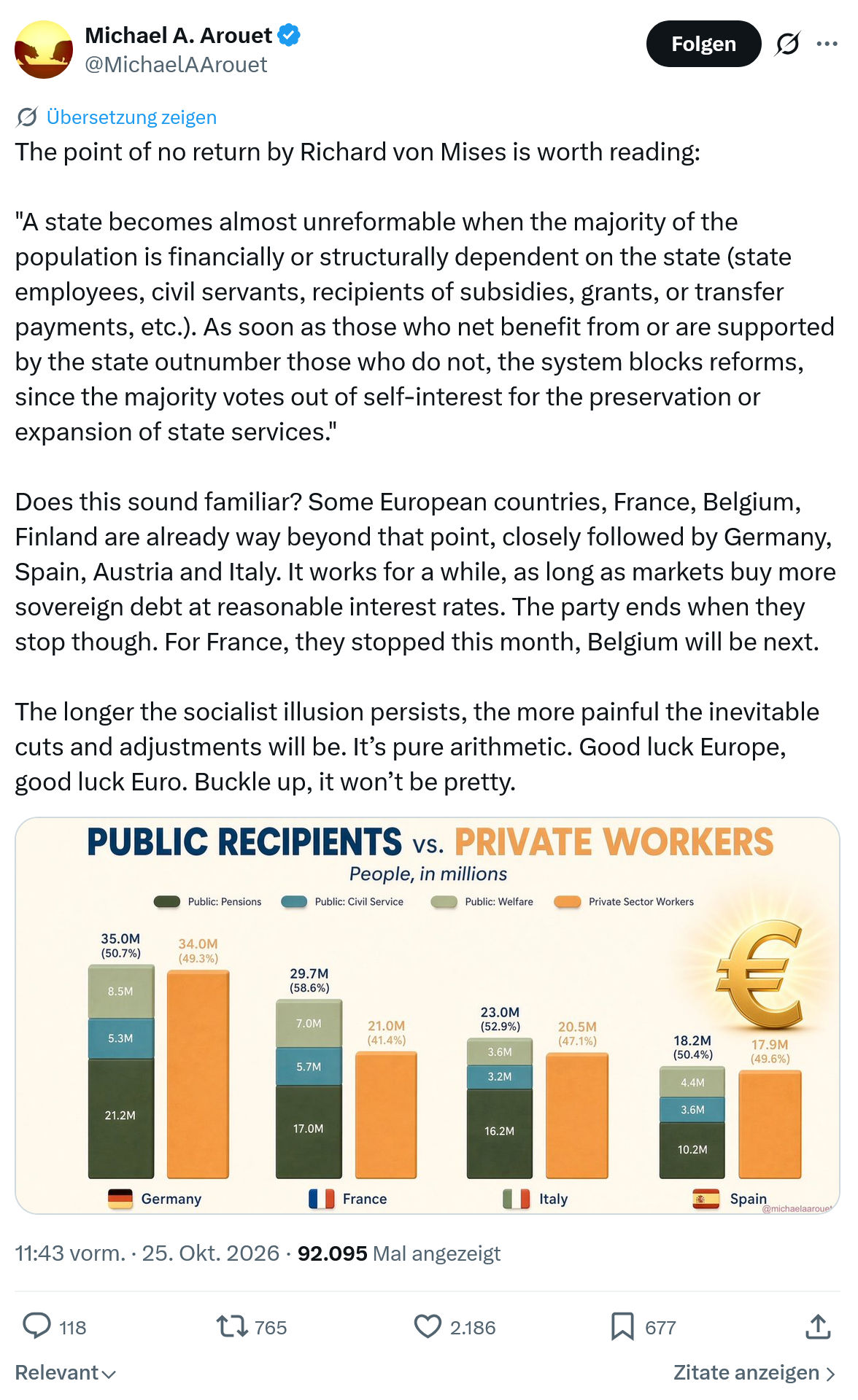
The point of no return by Richard von Mises is worth reading: "A state becomes almost unreformable when the majority of the population is financially or structurally dependent on the state (state employees, civil servants, recipients of subsidies, grants, or transfer payments, etc.). As soon as those who net benefit from or are supported by the state outnumber those who do not, the system blocks reforms, since the majority votes out of self-interest for the preservation or expansion of state services." Does this sound familiar? Some European countries, France, Belgium, Finland are already way beyond that point, closely followed by Germany, Spain, Austria and Italy. It works for a while, as long as markets buy more sovereign debt at reasonable interest rates. The party ends when they stop though. For France, they stopped this month, Belgium will be next. The longer the socialist illusion persists, the more painful the inevitable cuts and adjustments will be. It’s pure arithmetic. Good luck Europe, good luck Euro. Buckle up, it won’t be pretty.
Michael A. Arouet: The point of no return...
https://x.com/MichaelAArouet/status/2114276643044815238

Michael A. Arouet: If you thought that nothing...

If you thought that nothing more can surprise you in Germany, there is always the next highly entertaining absurdity popping up. Starting November 2026 German public broadcasters can access resident registration data to identify and pursue non-payers of the state broadcasting tax. At the same time no automatic data sharing exists between police and job centers to halt welfare benefits payments to individuals with active arrest warrants. Isn’t that simply hilarious? If you try to avoid paying for the state legacy media, there are of course no data protection concerns, and they will get you. If you are a criminal on an active arrest warrant, you keep receiving your welfare benefits. Germany is so messed up. Can you name a more entertaining country?

Michael A. Arouet: Apparently 348 taxes are not enough...

Apparently 348 taxes are not enough. Say hello to number 349. France plans a 0.8% levy on home, car, and business insurance contracts starting January 1, 2027, to fund a state-backed compensation mechanism for riot damages. The measure follows recent violence and looting. Insurers will pass the cost to policyholders through higher premiums, spreading the financial impact of riots across all French insured parties regardless of their location or involvement. Isn’t that simply hilarious? As response to cost-of-living protests France will seriously make all insurance policies more expensive? Here is an idea, maybe instead of sentencing rioters to 40 hours of social work, make them pay for the damages they cause? Why should all decent, lawful people pay for their violence, while criminals laugh about the lack of serious consequences? https://x.com/michaelaarouet /status/2076572534141600239/photo/1

Michael A. Arouet: German carmakers face their deepest...

German carmakers face their deepest structural crisis ever. Just look at their profits. Chinese competitors have eroded the high-margin Chinese market that long subsidized European operations, while Chinese brands gain share in Europe and other markets. Development cycles, cost structures, and software capabilities favor China. High German energy costs, rigid union-protected labor costs, and European plant overcapacity compound the problem. Volkswagen is preparing cuts of around 100,000 jobs. BMW, Mercedes-Benz, Porsche, and Audi have announced or are negotiating substantial reductions. The multiplier effect is brutal, each job cut at a major commonly ripples to as many as five supplier jobs. Tier-1s suppliers such as Bosch, ZF, Continental, and Schaeffler, plus hundreds of mid-size component makers, are already shedding tens of thousands of positions. The pain concentrates in Germany’s industrial heartlands, impacting communities and real estate. This is not only an automotive story, machinery, chemicals, electrical equipment, and other export-oriented sectors face the same Chinese pressure from faster product cycles, lower costs, and state-supported scale. Surveys show a quarter of German industrial firms already feel outmatched by Chinese rivals in Europe, and the bilateral trade deficit with China heads toward a new record above €100 bn. The industrial model that underpinned German prosperity for decades is under simultaneous strain at home and abroad. Neither industry nor politics has a real answer. German overregulation, bureaucracy, and rigidity make necessary adjustments almost impossible. Good luck, Deutschland.

Michael A. Arouet: Many people don’t realize...

Many people don’t realize how absurd European taxation is. Let’s take a look, shall we? A French employee, let’s call him Nicolas earns €100k gross per year, this would be nothing special in the US, but with €100k Nicolas is in the top 2% in France. First, after income tax and contributions, his net is roughly €64,250 a year. His employer pays another ~€42,000, for a total cost of ~€142,000. This means 55% in taxes and contributions, and only 45% for Nicolas. Second, when Nicolas wants to buy anything he pays another 20% in VAT. Third, when Nicolas tries to save for his retirement, his interest income is taxed at 31.4%, not on his real interest income, inflation is taxed as well. Then, when Nicolas dies his children face up to 45% inheritance tax. If you think that’s a lot, that’s not everything. France has 348 different taxes and levies, basically taxing everything that moves. Isn’t it entertaining that the French left seriously demands even higher taxes? In which parallel mental universe do these people live? Get a real job if you want to contribute to society.

Michael A. Arouet: This is eye-opening...

This is eye-opening. We've all heard Germany has stagnated for seven years, but closer look shows it's even much worse. Germany's real economy is in severe recession, the country „only“ stagnates overall due to inflated government spending financed by more debt. Germany still has some room to issue more debt, but this path leads straight to economic demise. It will become another failed left country like France, with an absurd state spending ratio, anemic structural growth, and a rapidly rising debt and interest burden. This is an epic failure of the German political class on both sides of the spectrum. They chose to mask the deepest economic crisis since WWII with more debt and inflated government spending instead of pushing long-overdue structural reforms. Isn’t that highly irresponsible? Why are they doing that?

Michael A. Arouet: This is really eye-opening...

This is really eye-opening. Most Germans don’t yet understand what is coming. Germany has gone from a global manufacturing superpower to an expensive, unproductive, inefficient sick man of Europe. No one in Europe works fewer hours per year than the Germans. Mentally stuck in the last century, they waste time on bureaucracy, regulations, unions and works councils, while others focus on productivity and efficiency. And then the left tells them every day that they don’t need to work harder, that “tax the rich” will solve the problem instead. Germany will buy a few years with more debt to mask its decline, left laziness and complacency. This won’t last forever. The current wave of weekly insolvencies and mass layoffs will one day feel like a walk in the park compared with what is coming. Prosperity is not granted forever.

Michael A. Arouet: France is already paying crisis-era...

France is already paying crisis-era rates to borrow, but the French left’s current reaction to the emerging debt crisis makes it even scarier. Their answers make the reasons for those rates more credible. Left presidential candidate Jean-Luc Mélenchon has seriously proposed a sovereign default on the hundreds of billions held by the Banque de France. Relabeling it a freeze or a zero-coupon perpetual does not change the substance, a default on debt the Eurosystem already holds. This would push French yields on new debt from 5% probably well above 10% going forward, and take Italian, Spanish and Belgian sovereign debt yields with them. The rest of the left is a little less theatrical, but not much more useful. They seriously threaten to bring down a government over €54 billion in savings and plan street blockades while the interest bill rises. This would clearly calm the markets. The Socialists, as always, talk about higher taxes in a country with one of the highest tax burdens, and most taxes in the world, already throttling growth and investment. Absolutely no one on that side offers a path that stabilizes the debt ratio by addressing the absurd French pension system and grotesque state spending. Refusal is treated as a program. If it wasn’t so sad to watch, it would be quite funny.

Michael A. Arouet: Isn’t it hilarious that leftists...

Isn’t it hilarious that leftists keep raising income-tax rates and introducing wealth taxes, then always act surprised when revenues fall? When the state treats success as a piggy bank, the mobile simply leave and those who stay stop working hard, innovating, and creating jobs. France tried it, the wealth tax raised little and triggered an exodus of millionaires, capital, income taxes, and the jobs that went with them. Sweden dropped its wealth tax for the same reasons: high administration costs, valuation disputes, and people voting with their feet. A wealth tax is especially counterproductive, it damages revenues, jobs, and growth. It hits unrealized gains, illiquid businesses, and people whose “wealth” is a company that employs others and drives innovation. Punish the builder and you lose not just one taxpayer but the jobs, prosperity, and future tax base that never get created. Why is this so hard for leftists to grasp? Why are they so blinded by envy and their own failure in life?

Michael A. Arouet: Italy, Spain, Germany...

Italy, Spain, Germany and some other European countries built some of the world’s most solid pension systems. They are now running out of children. Fertility sits around 1.1–1.4. Italy and Spain are among the oldest large nations on earth. The ratio of workers to retirees is collapsing. Pensions and healthcare are pay-as-you-go systems designed for a pyramid, not an inverted one. Mass immigration is sold as the easy patch, but is it? Young arrivals can delay the crunch for a few years if they work and pay in. Large inflows into welfare, informal work or low-productivity jobs do the opposite: they raise immediate fiscal costs, strain housing, healthcare and schools, and add future claimants who will also grow old. Low-skill migration does not restore the contributor-to-beneficiary ratio these systems urgently need. It often worsens the net fiscal picture over a lifetime while leaving the native birth collapse untouched. What makes it even worse, competition for entry level jobs in countries with high youth unemployment like Spain makes it even harder for young people to find a job and start a family. You cannot import a working-age population forever without caring about background and integration. That creates two-tier societies that erode the solidarity the welfare state depends on. The honest conversation is harder: why families of two or three children became economically and culturally rare, and why housing, work and time no longer line up with having kids? Mass immigration of the current mix is a delay tactic. Is it the right solution though?

Michael A. Arouet: Believe it or not...

Believe it or not, but France charges a child €58k to inherit a €400k family home from his mother. Italy, Spain, Germany, the UK, Poland, Portugal: €0. United States: $0. One country treats a modest family home like a taxable windfall. The others treat it as what it is: a parent passing on what they already paid tax on all their life to a child. You can't call it solidarity, you can't call it fairness. It is stealing from the dead. Prove me wrong.
Read more